

Payroll used to be one of those tasks businesses handled in batches – process everything, then report everything later. But that approach doesn’t work anymore. With the introduction of Single Touch Payroll (STP) in Australia, payroll reporting has shifted from a periodic task to a real-time responsibility.
For small business owners, this change can feel overwhelming at first. But once you understand how STP works, it actually simplifies payroll, improves accuracy, and reduces compliance stress – if it’s set up properly.
Let’s break it down in a way that makes sense, without the jargon.
Single Touch Payroll is a system introduced by the Australian Taxation Office (ATO) that requires businesses to report payroll information every time employees are paid.
Instead of submitting data at the end of the year, STP ensures that key payroll details are reported in real time through STP-enabled software.
Each pay run automatically sends:
This means your payroll data is always up to date with the ATO, reducing the need for separate reporting later.
STP is not just about compliance – it changes how payroll integrates with your overall financial system.
Previously, many businesses treated payroll and bookkeeping as separate tasks. Now, they are closely connected. If your payroll is incorrect, your reporting is incorrect too.
For businesses managing small company bookkeeping, STP adds an extra layer of responsibility. It requires your payroll records, financial data, and reporting systems to stay aligned consistently – not just at the end of the year. For a clearer understanding of how payroll connects with everyday financial processes, you can explore this guide on how payroll fits into day-to-day bookkeeping for small businesses.
STP applies to almost every employer in Australia, including:
Even if you have only one employee, STP compliance is mandatory. The only exceptions are limited and typically apply to very specific circumstances.
If you process payroll, you are expected to report through STP.
STP is designed to work seamlessly with payroll software. Once set up correctly, it becomes part of your normal payroll routine.
Each time you run payroll:
There is no need to submit separate reports manually. However, this also means errors are reported immediately – so accuracy becomes more important than ever.
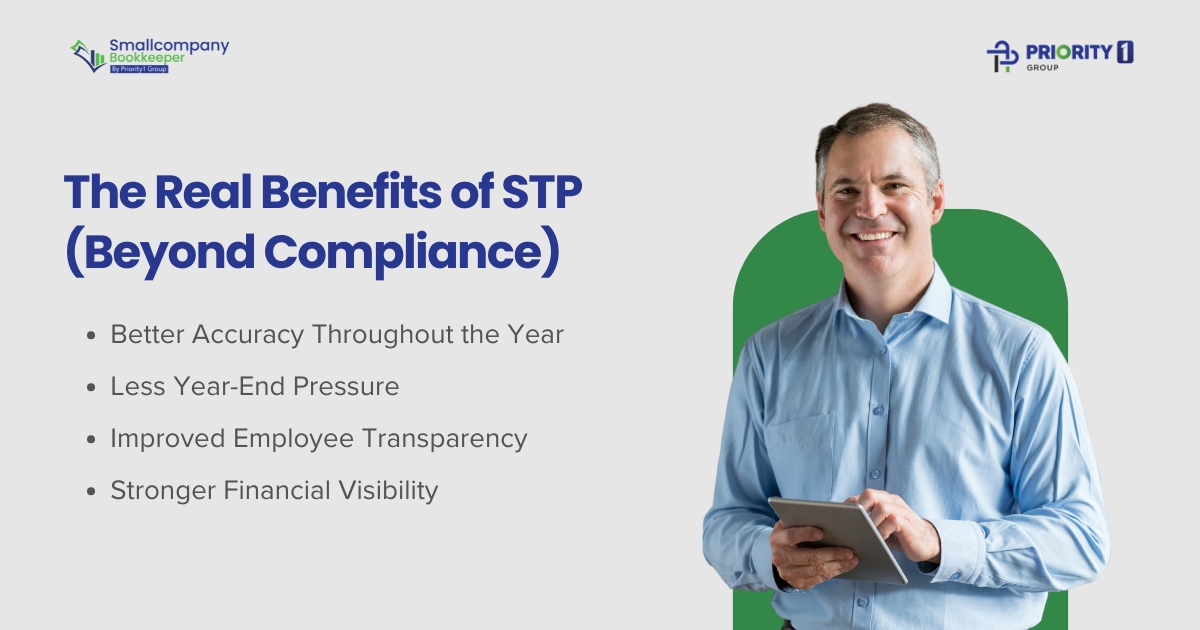
While many business owners initially see STP as an obligation, it actually offers several practical advantages.
Because reporting happens regularly, errors are identified earlier. This reduces the risk of large corrections at EOFY.
There’s no need to prepare payment summaries manually. Most payroll data is already finalised and submitted.
Employees can view their income, tax, and super details through their myGov account, reducing queries and confusion.
STP encourages consistent payroll processing, which improves overall financial clarity.
Even with automation, mistakes still happen – usually due to poor setup or inconsistent processes.
One of the most common issues is incorrect employee data. Small errors in tax file numbers, pay categories, or super details can lead to reporting discrepancies.
Another frequent mistake is relying too heavily on software without reviewing the output. Automation can repeat errors just as easily as it processes correct data.
Businesses also struggle when payroll is disconnected from bookkeeping. If payroll data doesn’t match financial records, reports become unreliable and compliance risks increase.
This is why many businesses work with bookkeepers for small business to ensure payroll and bookkeeping systems stay aligned and accurate.
STP compliance doesn’t require complex systems – it requires consistency and structure.
Start by ensuring your payroll software is STP-enabled and properly configured. This is the foundation of everything.
Next, maintain accurate employee records. This includes wages, tax settings, super contributions, and employment details.
Most importantly, create a routine. Payroll should be processed on time, reviewed regularly, and reconciled with your financial records.
When these basics are handled consistently, STP becomes a smooth process rather than a stressful one.
As your business grows, payroll becomes more than just paying employees – it becomes a compliance and reporting system.
More staff means more complexity. More transactions mean more chances for error. And more reporting means higher expectations from the ATO.
This is where structured support can make a real difference. For many growing businesses, working with an outsourced bookkeeping partner helps maintain accuracy, consistency, and compliance without adding internal workload.
There is a company called Priority1 Group that helps small businesses across Australia manage payroll and bookkeeping systems more effectively. By ensuring STP is set up correctly, maintaining accurate payroll records, and aligning reporting with financial data, they help reduce compliance risks and improve overall clarity.
Instead of reacting to payroll issues, businesses can operate with confidence, knowing their systems are working properly in the background.
Many business owners think STP is just about sending data to the ATO. But the bigger picture is this: STP forces businesses to improve their systems.
When payroll is consistent:
In other words, STP is not just a reporting requirement – it’s a system upgrade.
Single Touch Payroll has changed the way Australian businesses manage payroll. While it may seem like an added responsibility at first, it ultimately simplifies reporting, improves accuracy, and reduces the pressure of year-end compliance.
The key to making STP work is not complexity – it’s consistency. With the right systems in place, payroll becomes a smooth and predictable process rather than a reactive task.
If your payroll or bookkeeping systems feel inconsistent or unclear, working with a team like Priority1 Group can help bring structure and reliability to your operations. With the right support, you’re not just meeting STP requirements – you’re building a stronger financial foundation for your business.
Because at the end of the day, payroll isn’t just about compliance – it’s about running your business with clarity, control, and confidence.