

GST can look simple on paper, but for many Australian business owners, it becomes confusing the moment real transactions start flowing through the business. Sales come in, suppliers issue invoices, software auto-codes expenses, and BAS deadlines arrive faster than expected. If GST is not handled properly throughout the year, small errors can build into bigger reporting issues, cash flow problems, and unnecessary stress.
For Australian businesses, GST is generally a 10% tax on most goods and services sold or consumed in Australia. If your business is registered, you usually need to include GST in taxable sales, collect it from customers, and report it through your BAS.
This is why GST should never be treated as a once-a-quarter task. It needs attention all year round. The businesses that stay on top of it are usually the ones with cleaner records, more accurate BAS preparation, and fewer nasty surprises when it is time to review the numbers.
Many owners think GST is just about charging an extra 10% and passing it on to the ATO. In reality, it affects pricing, invoicing, expense claims, software setup, record keeping, and cash flow planning. Stripe’s GST guide notes that getting GST wrong can mean undercharging customers, overpaying tax, or dealing with compliance issues later.
The real problem is not usually one big mistake. It is a series of smaller ones. A supplier invoice gets coded incorrectly. A personal expense gets mixed in with business spending. A tax invoice goes missing. A business crosses the GST threshold but delays registration. Over time, these issues can make your BAS less accurate and your records much harder to trust.
One of the most important rules for small businesses is knowing when you need to register. According to the ATO, you generally must register for GST if your GST turnover is $75,000 or more, or $150,000 or more for non-profit organisations. The ATO also says registration is usually required within 21 days of meeting the threshold.
This matters because many owners confuse turnover with profit. GST registration is based on turnover, not how much profit you take home. That means a business can still need to register even if margins are tight.
Some businesses choose to register voluntarily before hitting the threshold. That can make sense in certain situations, especially where most customers are other GST-registered businesses and where the business has eligible GST credits to claim. But voluntary registration also means ongoing reporting obligations. It should be a considered decision, not a rushed one.
Not every sale is treated the same way. If your business is registered, you usually charge GST on taxable sales, but some sales may be GST-free or input taxed depending on the nature of the goods or services. This is one reason generic bookkeeping habits often fail businesses once they start growing.
This is where proper transaction review matters. If you charge GST where it should not apply, you can affect your pricing and you’re reporting. If you fail to charge GST where it does apply, you may end up covering that amount yourself later. Either way, poor treatment of sales creates problems that are much easier to prevent than to fix.
For businesses wanting reliable small company bookkeeping, GST accuracy starts with correctly identifying what type of sale or purchase sits behind every number in the software.
Xero, MYOB, QuickBooks, Hubdoc, Dext, Zoho Books, Tanda, and Deputy can all make business admin easier, but none of them remove the need for review. Automation is helpful, not perfect. If the GST code is set up incorrectly, the same mistake can repeat itself every week without anyone noticing.
This is especially risky in businesses with high transaction volume, mixed expense categories, staff reimbursements, recurring supplier invoices, or industry-specific transactions. Hospitality, healthcare, construction, retail, and professional services all have practical bookkeeping issues that can affect GST outcomes if the system is not being checked regularly.
A better approach is to reconcile accounts consistently, review coding monthly, and investigate unusual entries before BAS time. That is also where experienced support from Priority1 Group can add real value, especially for businesses that need structured finance processes rather than last-minute clean-up work.
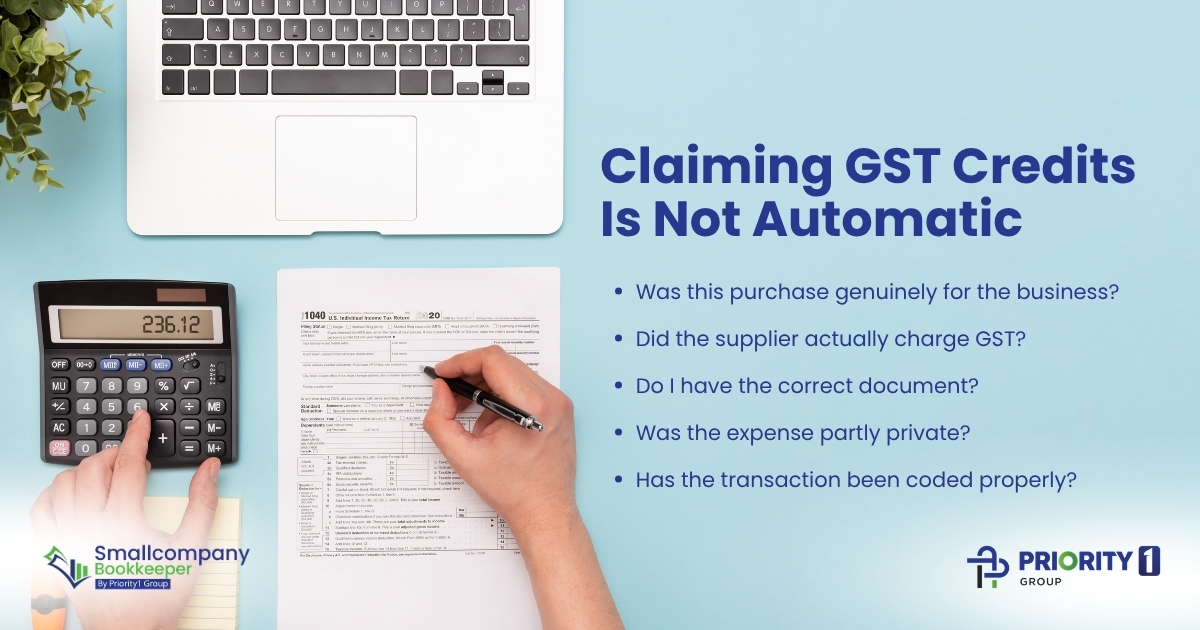
A lot of small business owners assume that if money has been spent, GST can be claimed back. That is not always true. The ATO states that to claim a GST credit, you must be registered for GST, the purchase must be for your business, and you generally need a valid tax invoice for purchases over $82.50 including GST. If a customer asks for a tax invoice, suppliers generally must provide one within 28 days unless the sale is $82.50 or less including GST.
That means you should regularly ask:
These questions matter more than many people realise. A casual approach to claiming GST credits can lead to overclaiming, underclaiming, or messy corrections later.
The ATO uses the BAS system for businesses to report and pay taxes including GST and PAYG. Monthly BAS is generally due on the 21st day of the following month, while quarterly activity statement due dates commonly fall on the 28th day after the quarter ends, with some specific timing variations such as quarter 2 often having a later due date.
What this means in practice is simple: BAS should be the outcome of good bookkeeping, not the beginning of it.
Businesses that wait until the last minute often find themselves dealing with:
missing invoices
unreconciled bank transactions
incorrect GST coding
duplicate expenses
unclear payroll entries
old accounts receivable and payable balances
That is why bookkeeping services for small businesses are often most valuable before a deadline, not on the day of it. When the books are kept current, BAS becomes a review process rather than a rescue job.
If you want to keep GST under control throughout the year, the most effective approach is consistency. Good GST management does not come from last-minute BAS preparation. It comes from keeping your records accurate, organised, and up to date every month.
A sensible GST routine includes:
Regular reconciliations are especially important because even small errors can affect your reporting, cash flow visibility, and GST accuracy. Problems such as duplicate transactions, missing entries, or incorrect coding can lead to confusion at BAS time if they are not picked up early. If you are already facing reconciliation issues, read our guide on fixing out-of-balance issues in Xero’s bank reconciliation report to understand the common causes and what to check.
This kind of monthly discipline leads to cleaner reports, better financial visibility, and fewer corrections later. It also gives business owners a more accurate picture of where the business stands, instead of relying on rushed figures at the end of each quarter.
Some GST mistakes are seen over and over again:
Stripe’s guide specifically highlights common issues such as getting GST math wrong, forgetting to claim credits, keeping poor records, and misclassifying sales.
The pattern is clear. Most GST problems are not caused by complexity alone. They are caused by poor processes, delayed reviews, and over-reliance on software or memory.
Getting GST right year-round is not just about staying compliant. It is about keeping your business organised, protecting cash flow, improving reporting accuracy, and avoiding stress when BAS deadlines arrive. The businesses that handle GST well are usually the ones that maintain strong bookkeeping habits month after month, not just when the ATO due date is getting close.
If your records feel messy, your GST setup is unclear, or your software is not giving you confidence, it may be time to get expert help. A dependable bookkeeping process can make a major difference to the way your business runs. For businesses that want clearer numbers and smoother compliance, support from Priority1 Group and practical guidance through small business bookkeeper can help turn GST from a recurring headache into a managed part of your operations.