

For many Australian small business owners, BAS time arrives with the same feeling every quarter: pressure, confusion, and a last-minute rush to fix incomplete records. But BAS lodgement should not feel like a clean-up operation. When your books are maintained properly throughout the reporting period, BAS becomes far more manageable.
A Business Activity Statement is used to report and pay obligations such as GST, PAYG withholding, PAYG instalments, and in some cases other tax amounts depending on the business. The ATO makes it clear that BAS due dates vary by reporting cycle, and monthly BAS is generally due on the 21st day of the following month, while quarterly due dates are commonly shown on the statement itself and follow the standard ATO schedule.
This guide gives small business owners a practical BAS lodgement checklist that is not just about ticking boxes before the deadline. It is about preparing the right records, checking the right numbers, and avoiding the common mistakes that lead to BAS stress.
One of the biggest problems with BAS is that many businesses only think about it when the due date is close. That is usually when issues start appearing. Missing receipts, unreconciled accounts, GST coding mistakes, duplicate transactions, and payroll mismatches all surface at once.
The ATO specifically advises businesses to focus on getting GST right, reviewing figures carefully, and checking records before lodging. It also encourages businesses to make BAS time easier by separating GST, reviewing cash flow, and staying on top of record keeping. For a more detailed breakdown of how to stay compliant, you can explore this guide on ATO compliance best practices
In other words, BAS preparation is not really a quarterly task. It is the result of good monthly bookkeeping.
Before you prepare anything, confirm your BAS due date. The ATO states that the due date to lodge and pay a monthly BAS is generally the 21st day after the end of the taxable period. For quarterly reporting, the due date is shown on the BAS, and the ATO maintains the current lodgement schedule on its BAS guidance pages.
This matters because your review process should begin well before the deadline. If you leave everything until the final few days, there is very little room to investigate discrepancies properly.
This is one of the most important steps before BAS lodgement. If your accounts are not reconciled, your sales, purchases, and GST figures may not reflect what actually happened in the business.
Before BAS is prepared, make sure:
This is where reliable small company bookkeeping makes a major difference. If reconciliations are done consistently throughout the month, BAS preparation becomes much easier, and the figures are far more trustworthy.
Your BAS cannot be accurate if your sales are incomplete or incorrectly classified. The ATO’s Simpler BAS GST bookkeeping guide explains that GST reporting relies on correctly classifying sales and purchases, including total sales and GST on sales.
Before the deadline, review whether:
A common mistake is assuming software defaults are always right. They are not. If the wrong tax code is attached to a recurring invoice template, the same BAS error can repeat for months before anyone notices.
A rushed BAS often happens because the supporting documents are scattered across emails, paper files, phones, and different systems. That makes it much harder to verify purchases and claim GST correctly.
The ATO’s GST and BAS guidance makes clear that record quality matters, especially when claiming GST credits and checking what belongs in each BAS period.
Before lodging, check that:
This is one of the reasons bookkeeping services for small businesses are often worth the investment. When records are organised as transactions happen, BAS time becomes a review process rather than a frantic document chase.
Incorrect GST coding is one of the most common causes of BAS errors. The ATO provides specific BAS and GST tips to help businesses avoid reporting mistakes and correctly handle adjustments.
Review your file for:
This is especially important if you operate in hospitality, retail, healthcare, construction, real estate, or professional services, where transactions can vary and bookkeeping shortcuts often create problems later.
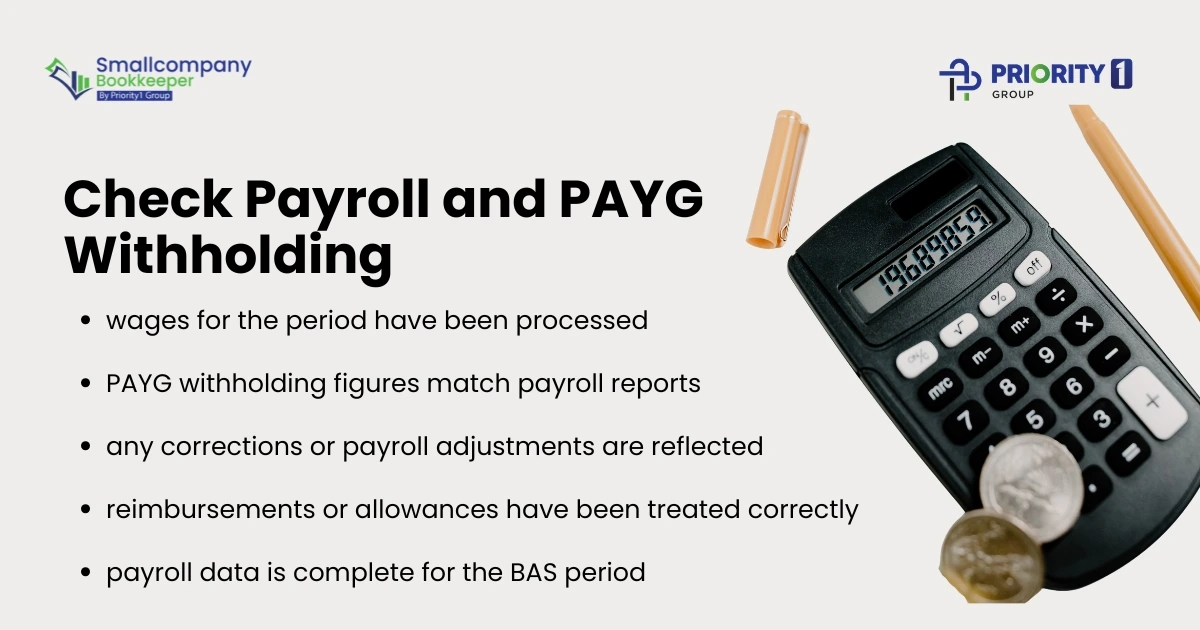
If your business has employees, BAS preparation should include a payroll review. The ATO states that BAS is used to report obligations including PAYG withholding, so your payroll records need to align with what is being reported.
Before BAS lodgement, confirm that:
If payroll records are out of sync, the BAS may still be lodged, but the underlying data will be weaker and more likely to require correction later.
Competitor blogs often stop at GST and payroll, but this is where a stronger checklist adds more practical value. BAS may focus on tax reporting, but your payables and receivables tell you whether the books are actually up to date.
Before lodging, look at:
This step helps identify broader bookkeeping issues that may not be obvious from the BAS summary alone.
Not every BAS issue starts in the current period. Sometimes you discover an old coding mistake, a duplicate claim, or an earlier omission while reviewing the current quarter. The ATO explains that BAS mistakes and adjustments need to be handled correctly, and specific labels such as 1A and 1B may be used depending on whether the change relates to GST on sales or GST on purchases.
Before you lodge, ask:
A careful review here can prevent the same issue from rolling forward again. Businesses that regularly encounter these kinds of issues may benefit from external support, such as working with Outsourced Bookkeeper, to ensure errors are identified and corrected early.
A BAS can be technically correct and still create financial stress if the GST collected has already been absorbed into everyday cash flow. The ATO’s small business newsroom recently advised businesses to keep the GST they collect separate, so they are ready for BAS time.
This is a simple but powerful habit. It helps avoid the situation where the BAS amount is accurate, but the business struggles to pay it because the funds were never set aside.
Once the numbers are prepared, do not just lodge whatever the software shows. Review the final BAS and ask whether the figures make commercial sense.
Look at:
The ATO’s BAS and GST tips encourage businesses to review their information carefully rather than treating the lodgement as a data dump from their software.
The easiest BAS periods are usually the ones where the bookkeeping has already been looked after consistently. Regular reconciliations, timely data entry, proper GST coding, and organised document storage remove most of the pressure.
This is where Priority1 Group can support growing Australian businesses. Whether the issue is late reconciliations, unclear GST treatment, weak reporting habits, or payroll records that do not line up, a more structured bookkeeping process can make BAS preparation smoother and more reliable long before the due date arrives.
BAS lodgement should not be a last-minute scramble built around missing paperwork and uncertain numbers. A better process is simple: reconcile your accounts, complete your sales and purchase records, review GST coding, confirm payroll figures, check for adjustments, and make sure the final BAS reflects what actually happened in the business.
That approach reduces stress, improves accuracy, and gives small business owners better visibility over their finances all year round. Strong records also make it easier to stay compliant, manage cash flow, and avoid the usual BAS panic.
If your business needs a cleaner system and more dependable support, Priority1 Group can help you build better habits through practical bookkeeping services that keep your records organised and your BAS preparation on track.