

Managing finances in the hospitality industry is a challenging task that requires precision and consistency. Whether you own a café, a restaurant, or a bar, keeping accurate and organised financial records is essential for smooth operations and long-term success. Hospitality bookkeeping goes beyond simple financial record-keeping; it’s about understanding the financial dynamics that affect the profitability of your business and staying compliant with Australian tax regulations.
In this blog, we’ll delve into the specific challenges that the hospitality industry faces when it comes to bookkeeping and provide actionable tips for keeping your finances organised, compliant, and under control. By the end, you’ll understand how to streamline your bookkeeping processes and avoid common mistakes that can lead to financial confusion and costly errors.
For business owners in the hospitality sector, small company bookkeeping is more than just a requirement—it’s the foundation of running a successful and sustainable business. Accurate bookkeeping allows you to track your cash flow, forecast profits, monitor costs, and ensure tax compliance. Without it, your financial health is unclear, and making informed decisions becomes difficult.
In hospitality businesses, where expenses such as food and beverage costs, staff wages, and overheads can fluctuate significantly, having a clear financial picture is crucial to avoid cash flow issues and maintain profitability.
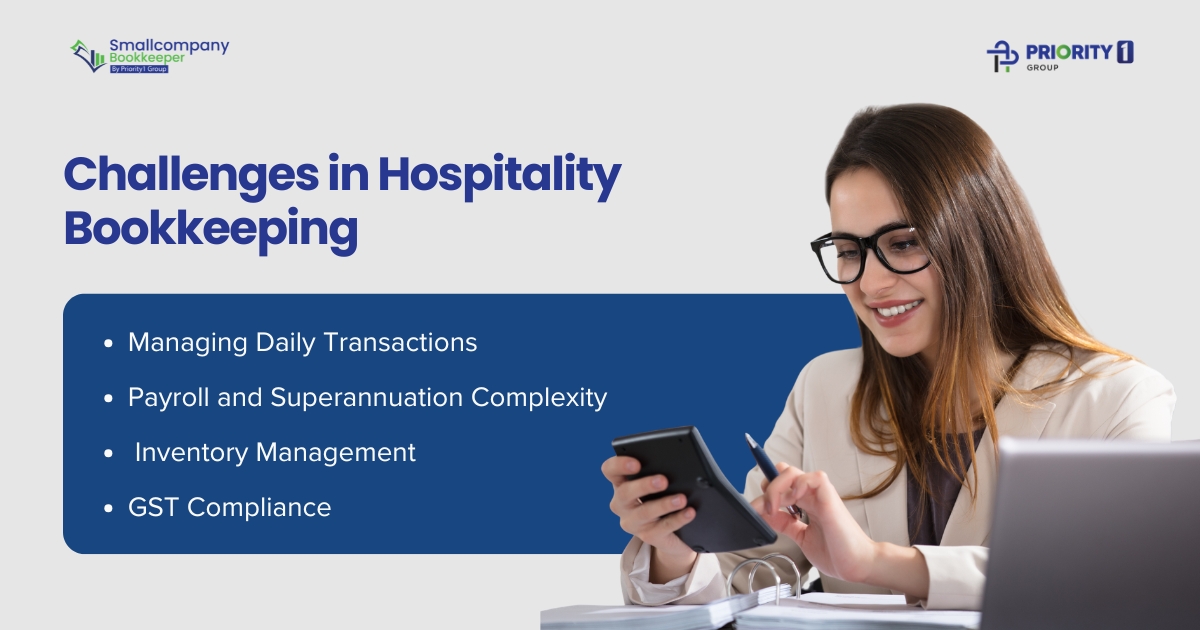
Running a hospitality business involves handling multiple revenue streams, managing high employee turnover, and dealing with unpredictable sales. As such, bookkeepers for small business often find hospitality accounting to be more complex than traditional bookkeeping. Here are some of the key challenges:
Restaurants, cafés, and bars deal with large volumes of daily transactions. This includes cash sales, credit card payments, and tips, all of which need to be tracked and recorded accurately. If transactions aren’t entered correctly or reconciled frequently, the records can become disorganised, leading to discrepancies that can affect tax filings, inventory management, and cash flow predictions.
The hospitality industry is heavily reliant on casual staff, and many employees work irregular hours. This makes payroll management more complex. Calculating wages, overtime, penalty rates, and superannuation contributions can be time-consuming and prone to errors if not handled correctly. In addition, there are tax obligations, such as PAYG withholding, that must be reported regularly.
Tracking inventory in the hospitality industry can be a daunting task. You need to account for the cost of goods sold (COGS), manage stock levels, prevent wastage, and ensure that the prices of items on the menu are correctly aligned with the actual cost of ingredients. Failing to keep accurate records of stock and purchases can lead to overordering, wastage, and reduced profit margins.
As a small business in Australia, you are required to collect and pay GST (Goods and Services Tax) on your sales if your annual turnover exceeds the GST threshold. Properly tracking GST is essential for submitting accurate Business Activity Statements (BAS). Mismanagement of GST can result in penalties from the Australian Taxation Office (ATO).
To avoid financial stress and remain compliant with ATO regulations, here are some actionable tips to optimise your hospitality bookkeeping:
Your chart of accounts is the backbone of your bookkeeping system. Make sure you create categories that reflect the unique nature of your hospitality business. This includes separating revenue streams like food, beverages, tips, and other sales categories. Accurate categorisation of income and expenses allows you to gain better insights into your profit margins and avoid financial discrepancies.
Adopting cloud-based bookkeeping software like Xero, MYOB, or QuickBooks can simplify your bookkeeping tasks and help you stay organised. These tools allow you to automatically import bank transactions, reconcile accounts, track GST, and generate financial reports in real-time. They also enable you to access your financial data from anywhere, which is especially useful for busy hospitality business owners who are often on the go.
Managing payroll manually is prone to errors, especially when dealing with staff working irregular hours. Automation tools can help streamline this process. By using software that automatically calculates wages, deductions, and superannuation, you ensure timely and accurate payments for your staff. If you’re using MYOB Bookkeepers, they can set up and automate payroll, making it easier to track employee hours and wages.
Many small business owners in hospitality struggle with the overwhelming administrative tasks that come with managing payroll, tracking expenses, and ensuring tax compliance. This is where outsourcing your bookkeeping can make a significant difference. Outsourced bookkeeping allows you to focus on running your business while an expert handles your financial records.
Outsourcing gives you several advantages:
If you’re interested in seeing how outsourcing can benefit your small business, consider exploring Outsourced Bookkeeper for a reliable solution to your bookkeeping needs.
As a small business owner, it’s easy to feel overwhelmed by the financial side of your business. While you may have the tools to manage day-to-day operations, professional bookkeepers for small business can ensure that your financial data is managed correctly and that you stay compliant with ATO regulations. Bookkeeping professionals not only handle payroll and taxes but also help you make more informed financial decisions.
If you’re struggling to stay on top of your finances, it’s time to consider working with Priority1 Group. They specialise in helping hospitality businesses streamline their bookkeeping and tax processes, ensuring accurate records and reduced stress.
Managing your finances in the hospitality industry may feel like a daunting task, but with the right approach and tools, it doesn’t have to be. By following best practices in hospitality bookkeeping, using the right software, and ensuring proper categorisation and tax compliance, you can take control of your business’s financial health.
Outsourcing your bookkeeping can also help streamline processes, reduce errors, and free up your time to focus on running your business. With expert support from Priority1 Group, your business can operate with confidence, knowing your financial systems are in good hands.