

Running a small business often means wearing several hats at once. One minute, you are speaking with a customer; the next, you are checking supplier invoices, following up on payments or trying to understand why your bank balance looks different from what you expected. In the early days, handling your own books may feel practical. You save money, stay close to the numbers and learn how your business operates.
But there is a point where DIY bookkeeping stops being a sensible cost-saving measure and starts becoming a distraction. The shift is not always dramatic. It usually happens slowly: a few unreconciled transactions, several invoices waiting to be entered and a financial report that you keep promising to review “next week”. Before long, your books are no longer helping you manage the business. They are becoming another problem to solve.
So, when should you hire a bookkeeper? The answer is not based only on the size of your business. It depends on how much time bookkeeping consumes, how accurate your records are and whether your financial systems can keep pace with your growth.
Doing your own bookkeeping is not necessarily a bad decision when your business is new. If you have a small number of transactions, no employees and a straightforward service offering, basic software and a consistent routine may be enough. You can issue invoices, record expenses and check your bank feed without losing too many hours each week.
The challenge begins when business activity increases but your bookkeeping process remains the same. A growing business has more moving parts. New customers bring additional invoices. More suppliers create extra bills. Hiring staff adds payroll responsibilities. Expanding your services can make income tracking more complicated. What once felt like a manageable weekend task can quickly become a bottleneck.
Australian businesses also need to maintain proper financial records. The Australian Taxation Office explains that businesses must keep records relating to transactions, tax, superannuation and registration affairs. Good records are not just useful during reporting periods. They give you a clearer view of what is happening inside your business every week.
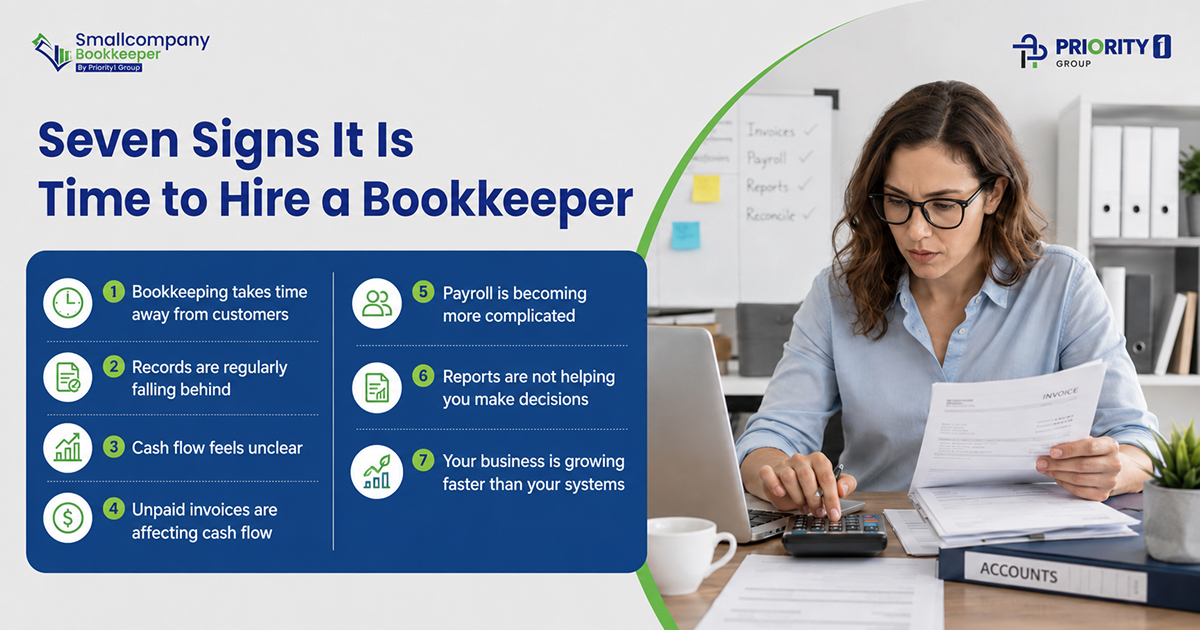
Your time has a value, even when you do not put a dollar figure on it. If you are spending evenings categorising expenses, chasing receipts or correcting entries, you may be sacrificing time that could be used to serve customers, improve operations or win new business. Saving a bookkeeping fee makes little sense if it prevents you from focusing on the work that generates revenue.
Think of it like repairing your own office plumbing. You might eventually fix the leak, but the hours spent watching tutorials and making trips to the hardware shop could cost more than hiring the right person from the beginning.
A backlog is one of the clearest warning signs. Perhaps the bank reconciliation is several weeks overdue. Maybe supplier bills are sitting in different inboxes, receipts are scattered across folders and expense categories are becoming inconsistent. These small gaps can snowball. When the records finally need urgent attention, the clean-up becomes more time-consuming and stressful than regular maintenance would have been.
Reliable Small company bookkeeping creates a routine rather than a last-minute scramble. Transactions are recorded consistently; accounts are reconciled regularly and issues are easier to identify while they are still manageable. Building a simple monthly bookkeeping routine can also help you maintain clearer records and stay in control as the business grows.
A busy business is not automatically a financially healthy business. Sales may look strong while your bank balance continues to feel unpredictable. That can happen when outgoing payments, delayed customer invoices and recurring expenses are not being monitored closely enough.
A bookkeeper can help organise your financial information so that you have a clearer picture of money coming in and going out. They do not replace your responsibility as the business owner, but they give you better visibility. It is much easier to steer the ship when the dashboard is working.
Late payments can create unnecessary pressure, especially when your own supplier bills and payroll obligations continue to arrive on schedule. If invoices are not issued promptly or outstanding balances are not followed up consistently, cash flow can become harder to manage.
This is where structured support matters. Bookkeepers for Small Business can help maintain invoicing processes, monitor accounts receivable and keep records updated. When your numbers are organised, you can make decisions based on facts rather than assumptions.
Hiring your first employee is an exciting step, but it also adds new responsibilities. Payroll needs to be accurate and completed on time. As the team grows, managing hours, leave records, pay runs, and supporting documentation becomes more demanding.
This is often the stage where professional assistance becomes valuable. Priority1 Group can support businesses with structured bookkeeping and payroll processes, allowing owners to spend less time on repetitive financial administration and more time building the business.
Financial reports should do more than sit in a folder. They should help you understand your income, expenses, outstanding invoices, and overall financial position. If you rarely review reports because they are outdated, confusing, or incomplete, your bookkeeping system is not doing its job.
The purpose of accurate records is not simply to tick a box. They should help you answer practical questions. Can you afford to hire another employee? Are costs increasing faster than revenue? Which months are typically quieter? Do you need to follow up on overdue payments? Clear reports turn bookkeeping from an administrative task into a useful business tool.
Growth has a way of exposing weak processes. A bookkeeping method that worked when you had ten invoices a month may not work when you have fifty. A spreadsheet that felt simple in your first year may become difficult to manage when you add staff, new services or multiple income streams.
Cloud-based systems can make bookkeeping more efficient, but software alone is not a complete solution. A tool can automate tasks, yet it still needs accurate setup, regular reviews and sensible processes. Businesses looking for software-specific support can explore QuickBooks Bookkeeper for assistance with bookkeeping systems and day-to-day financial management.
You do not need to hand over every financial task immediately. Begin with the areas that consume the most time or create the most pressure. These often include transaction recording, bank reconciliations, invoicing, accounts payable, accounts receivable, payroll support and regular reporting. Starting with repetitive tasks can provide quick relief while giving you a more reliable financial routine.
It also helps to understand the different ways outsourced support can work. Some businesses need a fully managed service, while others prefer a hybrid model where internal staff handle basic administration and an external bookkeeper reviews the records. For a closer look at your options, read this guide on how to outsource bookkeeping for your small business.
The right bookkeeper should make your financial systems easier to understand, not more confusing. Look for someone who communicates clearly, follows a consistent process and understands the needs of a growing small business. Ask how often reconciliations will be completed, what reports you will receive and how questions will be handled.
Industry familiarity can also matter. A service business, retailer, healthcare provider and construction company may each have different transaction patterns and administrative needs. Choose a provider that can adapt its support as your business changes rather than offering a one-size-fits-all approach.
Many owners delay hiring a bookkeeper because they see it as an expense. Yet the more useful question is: what is DIY bookkeeping already costing your business? The cost may appear as lost evenings, overdue invoices, unclear reports, missed opportunities or the stress of trying to clean up months of records at once.
Hiring support does not mean losing control of your finances. Done properly, it gives you more control because you can see what is happening without digging through spreadsheets and receipts. A good bookkeeper creates order behind the scenes so that you can lead the business with greater confidence.
Knowing when to hire a bookkeeper is less about reaching a specific revenue milestone and more about recognising when your current system is no longer serving you. If your records are behind, your cash flow feels unclear or bookkeeping is stealing time from customers and growth, professional support may be the next sensible step.
Priority1 Group helps Australian small businesses simplify bookkeeping, improve financial organisation and build processes that can scale as the business grows. The goal is not merely to keep the books tidy. It is to give you the clarity and time needed to make better business decisions.