

Tax time can feel like a race against the clock for small business owners. You are gathering receipts, reviewing transactions and trying to remember whether a purchase from nine months ago was personal, business-related or partly both. When records are incomplete, the focus often shifts from claiming legitimate deductions to simply getting the return prepared on time.
That rushed approach can cost your business money. Many deductible expenses are not dramatic purchases that immediately stand out in your bank feed. They are often smaller recurring costs, mixed-use expenses or ordinary payments that quietly disappear into the background during a busy year.
A tax deduction does not mean you receive the entire amount back. Instead, an eligible deduction generally reduces your taxable income. The rules also depend on your circumstances, so it is sensible to confirm your claims with a registered tax professional. However, understanding the commonly overlooked categories can help you ask better questions and keep more useful records throughout the year.
Bank fees are easy to miss because they often appear as small automatic deductions. Monthly account charges, merchant fees and eligible transaction costs may seem minor when reviewed individually, but they can add up over a full financial year.
Business finance costs may also require attention. Depending on the arrangement, eligible interest expenses and certain costs associated with borrowing for business purposes may be deductible. The important point is to separate genuine business expenses from personal spending and retain records that support the purpose of each payment.
Regular bank reconciliation helps identify these small expenses before they disappear into a long list of transactions. For a closer look at why reconciliations matter, read this guide on how small bookkeeping errors can affect your business.
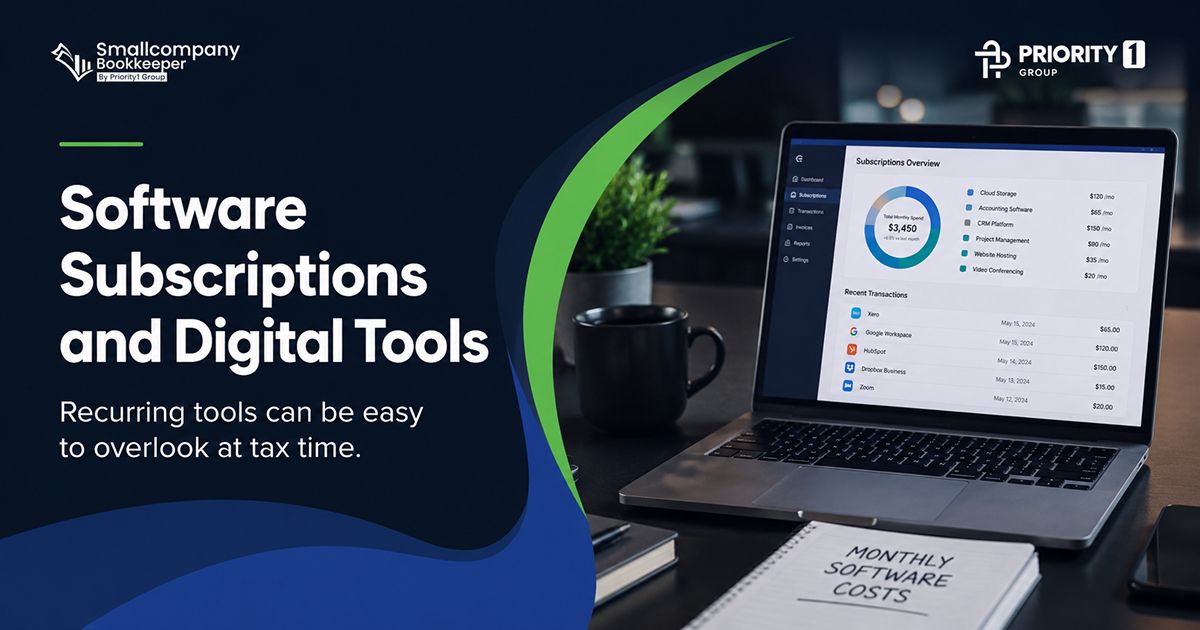
Modern businesses rely on software for almost everything. Accounting platforms, customer relationship management systems, project management tools, cloud storage, video conferencing subscriptions, website hosting and design applications can all become part of your monthly operating costs.
These payments are often overlooked because they may be charged automatically to a card. Some subscriptions are paid annually, while others appear as small monthly payments from multiple providers. When no one reviews the recurring expenses, useful deductions may be missed and unnecessary subscriptions may continue unnoticed.
Accurate Small company bookkeeping gives you a clearer record of these costs. It also helps you review whether your business is still using each tool. A subscription audit can uncover potential deductions while identifying services that no longer provide value.
Businesses using QuickBooks or looking for software-focused financial support can explore QuickBooks Bookkeeper for assistance with maintaining organised records and improving daily bookkeeping processes.
Running a business from home has become increasingly common. However, many owners either forget to claim eligible home-based business expenses or assume every household bill can be treated as a business deduction.
The reality is more balanced. You may be able to claim the business portion of certain expenses when you operate some or all of your business from home. Depending on your circumstances, this may include running costs such as electricity, internet and phone usage. Some businesses may also need to consider occupancy-related expenses, but the rules can vary depending on the business structure and how the home is used.
The key word is portion. If your internet connection is used for both work and personal streaming, the full amount is not automatically a business deduction. Keep clear records and use a reasonable method to calculate the business-related share.
Vehicle expenses are another area where small businesses can miss legitimate deductions or accidentally overclaim. If a motor vehicle is used for business activities, you may be able to claim eligible expenses relating to its business use.
Examples may include travel between business locations, visiting customers or collecting supplies. Ordinary private travel cannot simply be converted into a business deduction because the vehicle is also used for work.
Good record keeping matters here. A logbook, mileage records, invoices and receipts can help establish the business-use portion. When a vehicle is used for both personal and business purposes, the claim generally needs to be apportioned.
Business owners often invest in training without thinking about the potential tax implications. Courses, workshops and industry events may be deductible when they are sufficiently connected to the current business and help maintain or improve relevant skills.
Professional memberships and subscriptions to industry publications may also be overlooked. A small annual membership fee may not stand out like rent or payroll, yet it can still be part of the cost of operating your business.
Be careful with courses that prepare you for an entirely new occupation or business activity. The purpose and connection to your existing operations matter. Keep invoices, course outlines and notes about how the training relates to your business so your tax professional can assess the claim correctly.
Repairs and maintenance are commonly confused with improvements. If you pay to repair equipment used in your business, the expense may be treated differently from a purchase that upgrades the asset or creates a lasting improvement.
The distinction is important. Replacing a broken component is not necessarily the same as purchasing an entirely new asset. Capital purchases may need to be depreciated, although eligible small businesses may be able to claim an immediate deduction under the instant asset write-off rules when the relevant conditions are met.
For the 2025–26 income year, eligible small businesses with aggregated annual turnover under $10 million may be able to immediately deduct the business portion of qualifying assets costing less than $20,000. The threshold generally applies per asset. Before making a purchase purely for tax reasons, consider whether the item genuinely supports your business and confirm the treatment with your tax adviser.
Small businesses often pay for several types of insurance, including public liability, professional indemnity, workers compensation and cover for business assets. Eligible premiums connected to business operations can be easy to overlook when policies are renewed automatically.
Professional support costs may also be relevant. Depending on the nature of the service, bookkeeping, accounting and certain legal expenses associated with operating the business may be deductible.
Priority1 Group supports Australian small businesses with structured bookkeeping, reconciliations and financial administration processes. Keeping these costs categorised correctly throughout the year makes it easier to prepare useful financial reports and provide organised information at tax time.
A notebook, a postage charge or a low-cost office supply purchase may not seem important when you are focused on larger expenses. Yet small transactions can add up across an entire financial year.
The problem is not only the dollar value. When small purchases are ignored, your financial records become less accurate. This can affect budgeting, cash flow planning and tax-time preparation.
Bookkeepers for Small Business can help create a consistent process for recording everyday transactions before receipts disappear or card payments become difficult to identify. If your accounts need attention before tax time, this bookkeeping clean-up checklist provides a practical starting point.
The best time to think about deductions is not when your return is due. It is when the expense occurs. Save invoices, store digital receipts and add clear notes for transactions that may not be obvious later.
A monthly bookkeeping routine can make a significant difference. Review your bank transactions, reconcile accounts, check recurring subscriptions and separate private expenses from business purchases. This reduces the pressure at tax time and gives your accountant or tax adviser a clearer financial picture.
It also improves business decision-making. When your records are current, you can see where money is going, identify avoidable costs and plan for future expenses with greater confidence.
Small business tax deductions are often missed because everyday expenses are easy to overlook. Bank fees, subscriptions, home-based business costs, vehicle expenses, professional memberships, insurance and low-value purchases may all deserve attention when they are genuinely connected to business activities.
The answer is not to claim everything. It is to maintain accurate records, separate business and private expenses and seek professional guidance when the correct treatment is unclear.
Priority1 Group helps Australian small businesses improve bookkeeping processes, maintain clearer records and reduce the stress that often appears at tax time. A reliable bookkeeping routine can help you prepare more confidently while giving you better visibility over the financial health of your business.