

If you’ve ever glanced at your bank balance and thought, “That looks about right,” you’re not alone. Many small business owners rely on a quick check rather than digging deeper into their numbers. But here’s the reality – what looks “about right” can quietly drift into “completely off” if bank reconciliation isn’t done properly.
Bank reconciliation isn’t just an accounting task – it’s a control system for your business. It’s how you verify that every dollar coming in and going out is accounted for, accurate, and aligned with reality. And when this process is skipped or rushed, the cost isn’t always immediate – but it builds over time.
Let’s break it down in a way that actually makes sense – and more importantly, shows why getting it wrong can hurt more than you think.
At its core, bank reconciliation is simply comparing two versions of the truth:
Every transaction – sales, expenses, bank fees, transfers – should match across both records. If they don’t, something is missing, duplicated, or incorrectly recorded.
Think of it like syncing your phone with the cloud. If the sync fails, you lose data. In business, that “lost data” shows up as financial confusion.
For businesses handling small company bookkeeping, reconciliation is what keeps everything grounded. Without it, your reports might look clean – but they won’t be reliable.
Many business owners treat reconciliation as something to tick off at the end of the month. But it’s not just a task – it’s a checkpoint for financial accuracy.
Here’s why it matters more than most people realise:
Your profit and loss report might show you’re doing well. But if transactions are missing or misclassified, that profit could be misleading. Reconciliation ensures your numbers reflect what’s actually happening – not what you assume is happening.
Small errors don’t stay small. A duplicated expense, a missed payment, or an incorrectly coded transaction might seem minor – but over time, these stack up and distort your entire financial position.
When your books are reconciled, you can make decisions confidently. Pricing, hiring, investing – all of it depends on trusting your numbers.
Let’s talk about where things typically go wrong – because this is where money quietly slips through the cracks.
Sometimes payments don’t get recorded. Other times, expenses are forgotten. These gaps create an incomplete financial picture, making your reports unreliable.
Duplicate entries can often happen when transactions are imported more than once or incorrectly matched. This can inflate your expenses or income and distort your financial reports. If your books ever feel “off” and you can’t pinpoint why, it’s often linked to reconciliation issues like these. For a deeper breakdown of how to fix these problems, you can read this guide on fixing out-of-balance issues in Xero’s bank reconciliation report.
Monthly bank fees, interest, and small deductions are often ignored. But these still affect your bottom line and must be accounted for.
Payments in transit – like pending deposits or uncleared cheques – can create temporary mismatches. If not tracked properly, they can lead to confusion.
Even when transactions are recorded, placing them in the wrong category affects reporting accuracy. This impacts tax, cash flow analysis, and decision-making.
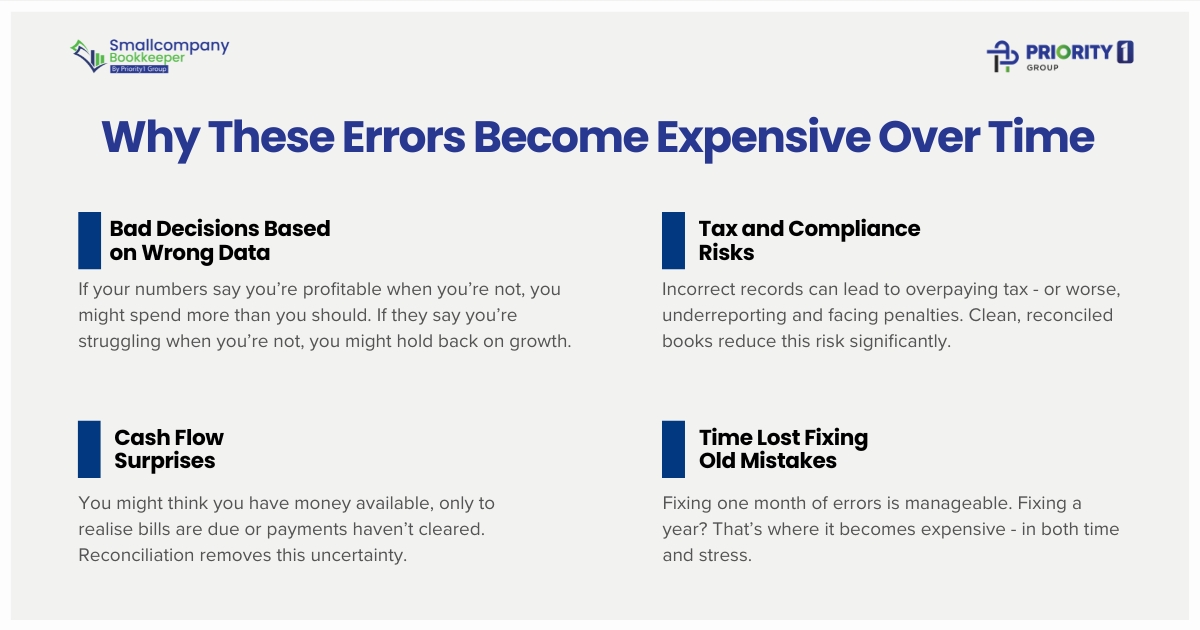
The real issue isn’t the error – it’s what the error leads to.
If your numbers say you’re profitable when you’re not, you might spend more than you should. If they say you’re struggling when you’re not, you might hold back on growth.
Incorrect records can lead to overpaying tax – or worse, underreporting and facing penalties. Clean, reconciled books reduce this risk significantly.
You might think you have money available, only to realise bills are due or payments haven’t cleared. Reconciliation removes this uncertainty.
Fixing one month of errors is manageable. Fixing a year? That’s where it becomes expensive – in both time and stress.
Monthly reconciliation is the standard for most small businesses. But if your transaction volume is high, weekly reconciliation can give you better control.
The key isn’t frequency alone – it’s consistency.
When reconciliation becomes part of your routine:
For many businesses, this is where working with bookkeepers for small business becomes valuable – they ensure the process is done consistently without adding pressure on the owner.
You don’t need a complex system – you need a repeatable one.
Cloud accounting platforms like Xero, MYOB, or QuickBooks make reconciliation easier by pulling in bank feeds automatically. But remember – automation helps, it doesn’t replace review.
Don’t let transactions pile up. The longer you wait, the harder it becomes to identify discrepancies.
Anything that doesn’t match should be investigated – not ignored. This is where most insights (and problems) are uncovered.
If something doesn’t fit your usual pattern, document it. Future-you will thank you when reviewing reports or preparing for tax time.
At some point, many business owners realise that staying on top of reconciliation while running the business becomes unsustainable.
Many businesses solve this by working with an outsourced bookkeeper who can manage reconciliations, maintain accuracy, and keep reporting consistent without adding pressure to the owner. That’s where structured support can change everything.
There is a company called Priority1 Group that helps small business owners across Australia bring consistency to their bookkeeping processes. By maintaining regular reconciliations, improving reporting clarity, and reducing financial noise, they help ensure your books are not just up to date – but actually useful for decision-making.
Instead of reacting to problems, you’re working from clean, reliable data.
Here’s something most blogs don’t tell you – reconciliation isn’t just about fixing errors. It’s about enabling growth.
When your books are accurate:
It’s like driving with a clear windshield versus a foggy one. The direction doesn’t change – but your ability to navigate does.
Bank reconciliation might seem like a background task, but it plays a central role in how your business operates. When it’s done consistently and correctly, it protects your finances, strengthens your decision-making, and keeps your business running smoothly.
When it’s ignored, errors build quietly – until they show up as cash flow issues, tax problems, or reporting confusion.
If your reconciliation process feels inconsistent or overwhelming, working with a team like Priority1 Group can help bring structure and clarity. With the right systems in place, your financial records become something you can rely on – not something you second-guess.
And that’s when bookkeeping shifts from being a task… to becoming a tool for growth.