

Hiring help is a big step for any small business. Whether you are bringing in someone to support daily operations, complete project work, manage admin, deliver services or help with customer demand, the arrangement needs to be set up correctly from the beginning. One of the biggest decisions is whether the person should be treated as an employee or an independent contractor.
At first, the difference can look simple. Employees usually work inside the business, while contractors are often engaged to deliver a specific service. But in real life, the line can become blurry. A person may have an ABN, send invoices and call themselves a contractor, yet the actual working arrangement may still create obligations that look much closer to employment.
Getting this wrong can become expensive. It may affect PAYG withholding, superannuation, leave entitlements, payroll tax, workers compensation and record keeping. For small businesses already managing tight cash flow, one incorrect classification can create a messy financial clean-up that takes far longer than expected.
An employee generally works within the business and is part of its ongoing operations. The business usually controls how, when and where the work is done. Employees may receive wages, leave entitlements, superannuation and other workplace protections, depending on their role and employment type.
A contractor usually runs their own business and provides services to another business. Contractors often decide how the work is completed, use their own tools or systems, take commercial risk and may work for multiple clients. They are usually paid for achieving an agreed result rather than simply being paid for time worked.
The important point is that the label alone does not decide the relationship. Calling someone a contractor in an agreement does not automatically make them one. The real arrangement matters. If the working relationship operates like employment, the business may still have employer obligations.
The classification affects more than how a person is paid. It influences tax, super, leave, workplace rights and business compliance. When a worker is an employee, the business may need to withhold PAYG tax, report wages through payroll systems, pay superannuation and keep detailed employment records.
Contractor arrangements can involve different tax and reporting treatment. However, some contractors may still be entitled to superannuation if they are paid mainly for their labour. This is where many small businesses get caught. They assume an ABN and invoice are enough, but the legal and financial obligations may go deeper.
This is why small company bookkeeping should not only focus on income and expenses. It should also help business owners understand how payments are being categorised. If wages, contractor invoices and super obligations are not recorded clearly, it becomes harder to identify risk before it turns into a bigger problem.
There is no single test that always answers the question perfectly, but there are practical signs that may point toward employment. If the business controls the worker’s hours, directs how the work must be done and expects the person to work only for that business, the arrangement may look more like employment.
A worker may also appear more like an employee if they use the business’s tools, wear the business uniform, work as part of the regular team and do not carry meaningful commercial risk. If they are paid for time worked rather than for delivering a specific result, that can also be relevant.
Think of it like hiring a driver. If someone runs their own delivery business, uses their own vehicle, sets their own schedule and serves multiple clients, they may look more like a contractor. If they wear your uniform, work set shifts, use your systems and take direction like your other staff, the arrangement may be different.
A genuine contractor usually operates independently. They may advertise their services, choose how to complete the work, provide their own tools, quote for projects and take responsibility for fixing defects or errors. They may also have the ability to subcontract or delegate the work, depending on the agreement.
Contractors are often paid for a result. For example, a web designer engaged to build a website for an agreed price may be different from someone working fixed weekly hours under close supervision. The contractor is usually responsible for managing their own business costs, insurance and tax affairs.
Even then, small businesses should be careful. A contractor can still create super obligations in some cases, especially when the arrangement is mainly for their personal labour. The business should look at the full relationship rather than relying only on the invoice format.
Misclassification can create several financial problems at once. If a worker should have been treated as an employee, the business may face unpaid super, tax withholding issues, leave-related claims and workplace entitlement disputes. Depending on the circumstances, penalties may also apply.
The costs are not only financial. Misclassification can damage trust with workers, create stress for the business owner and pull time away from customers and growth. A small issue that could have been reviewed early may become a major distraction when a complaint, audit or legal question arises.
Payroll processes are often where the issue first becomes visible. If your business is unsure whether payments belong in wages, contractor expenses or another category, it may be time to review your payroll accounting process before the records become harder to untangle.
One of the most common mistakes is assuming contractors never receive super. In Australia, some independent contractors may still be entitled to superannuation if they are paid mainly for their labour. This can apply even when the contractor provides an ABN and sends invoices.
This rule matters because unpaid super can become expensive. If super should have been paid and was not, the business may need to deal with additional reporting and charges. From a practical perspective, this means every contractor arrangement should be reviewed before payments are processed repeatedly.
Bookkeepers for Small Business can help by keeping contractor payments, payroll records and super-related information organised. They do not replace legal or tax advice, but good bookkeeping makes it easier to provide accurate information when professional guidance is needed.
Worker classification is not just a legal question. It is also a record-keeping issue. If your business cannot clearly show who was paid, what they were paid for, how the arrangement worked and whether super or withholding obligations were considered, the risk becomes harder to manage.
Good records may include contracts, invoices, timesheets, project briefs, payment summaries, super records, correspondence and notes about the arrangement. These documents help create a clearer picture of the relationship if questions arise later.
This is why payroll and bookkeeping should work together, not separately. For more practical context, this guide on how payroll fits into day-to-day bookkeeping explains why regular payroll records support smoother business operations.
The best time to review a worker arrangement is before the person starts work. Waiting until there is a dispute or ATO question can make the process more stressful and more expensive. Business owners should review the role, the level of control, the payment method, the worker’s independence and whether the arrangement is genuinely for a result.
Written agreements are useful, but they should match the real working relationship. A contractor agreement will not protect the business if the day-to-day arrangement operates like employment. The paperwork and the practical reality need to align.
Priority1 Group supports Australian small businesses with bookkeeping, payroll support and financial administration processes. Businesses that want external support with ongoing finance tasks can also explore Outsourced Bookkeeper for structured bookkeeping assistance.
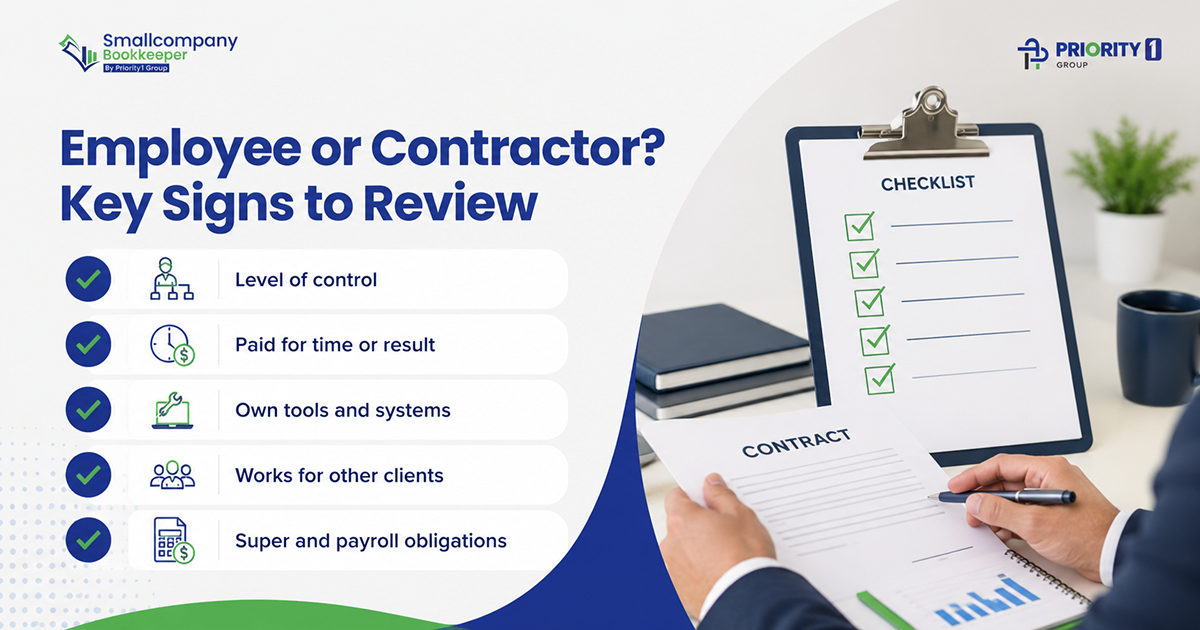
Before engaging a worker, ask a few practical questions. Will the person control how the work is done? Are they paid for a result or for their time? Do they use their own tools and systems? Can they work for others? Do they carry business risk? Are they integrated into your team like an employee?
You should also consider whether PAYG withholding, superannuation, workers compensation, insurance and payroll tax obligations may apply. If the arrangement is unclear, seek professional advice before the role begins.
A simple checklist cannot replace tailored guidance, but it can help you spot warning signs early. The goal is not to avoid hiring contractors or employees. The goal is to choose the right structure and support it with accurate records.
The employee vs contractor decision is one small business owners should never treat casually. The wrong classification can affect tax, superannuation, payroll, workplace entitlements and compliance. It can also create unnecessary stress when records are unclear or obligations have been missed.
A worker’s ABN, invoice or job title is not enough on its own. The real relationship matters. By reviewing arrangements early, keeping clear records and getting the right support, small businesses can reduce risk and operate with greater confidence.
Priority1 Group helps Australian small businesses improve bookkeeping systems, manage payroll-related records and build stronger financial administration processes. With the right support behind the scenes, business owners can spend less time worrying about compliance gaps and more time growing their business.