

Every small business reaches a point where bookkeeping stops being a simple task and starts becoming a system that needs structure. In the early stages, managing finances internally feels manageable. A few invoices, some expenses, and basic reporting seem enough to keep things under control. But as your business grows, so does the complexity – more transactions, more compliance requirements, and more pressure to stay accurate.
This is where the decision becomes important: should you continue with in-house bookkeeping, or shift to an outsourced model?
The answer isn’t just about cost. It’s about how efficiently your business can operate with reliable financial data behind it.
At a surface level, the difference between in-house and outsourced bookkeeping seems straightforward. In-house means you or your team handle everything internally, while outsourcing means handing over the responsibility to an external provider.
But in reality, the difference is much deeper. In-house bookkeeping gives you control, but it also demands time, consistency, and expertise. If the person handling your books lacks experience or is stretched across multiple responsibilities, errors can creep in quietly.
Outsourced bookkeeping, on the other hand, brings structure. Instead of relying on individuals, it relies on systems, processes, and specialised expertise. The focus shifts from “getting it done” to “getting it done correctly and consistently.” For many growing businesses, working with an outsourced bookkeeper is one of the most practical ways to introduce that structure without building an internal finance team.
For many businesses managing small company bookkeeping, this shift becomes necessary as soon as financial tasks start falling behind or reports stop reflecting reality.
Most business owners initially lean towards in-house bookkeeping because it appears cheaper. But what’s often overlooked is the total cost – not just the salary.
When you manage bookkeeping internally, you’re also investing in software, training, supervision, and time. And time is the most underestimated cost of all. Every hour spent fixing errors, chasing missing data, or preparing reports is time not spent growing the business.
Outsourcing, in contrast, usually operates on a predictable monthly cost. It removes hiring, training, and management overhead. More importantly, it reduces the risk of costly mistakes, which are far more expensive than the service itself.
The real question isn’t “Which is cheaper?”
It’s “Which gives better value for the time and accuracy required?”
Bookkeeping errors rarely create immediate problems. They build quietly over time.
A missed transaction here, a duplicate entry there, or incorrect categorisation might not seem significant at first. But eventually, these inconsistencies affect reporting, tax calculations, and decision-making.
With in-house bookkeeping, accuracy depends heavily on one person’s capability and availability. If that person leaves or falls behind, the entire system slows down.
Outsourced bookkeeping removes this dependency. It creates consistency through processes rather than individuals. This is why many growing businesses rely on bookkeepers for small business – not just for support, but for stability in their financial records.
Running a business already demands your full attention. Sales, operations, customer experience – these are the areas that drive growth.
Bookkeeping, while essential, is not where most business owners want to spend their time. Yet, when handled internally, it often becomes an after-hours task or something squeezed between other priorities.
Over time, this leads to delays, incomplete records, and reactive decision-making.
Outsourcing changes that dynamic completely. Instead of managing bookkeeping daily, you shift towards reviewing accurate reports and making better decisions. If you want to understand how this transition works in practice, you can explore this guide on simplifying your financial management through outsourced bookkeeping.
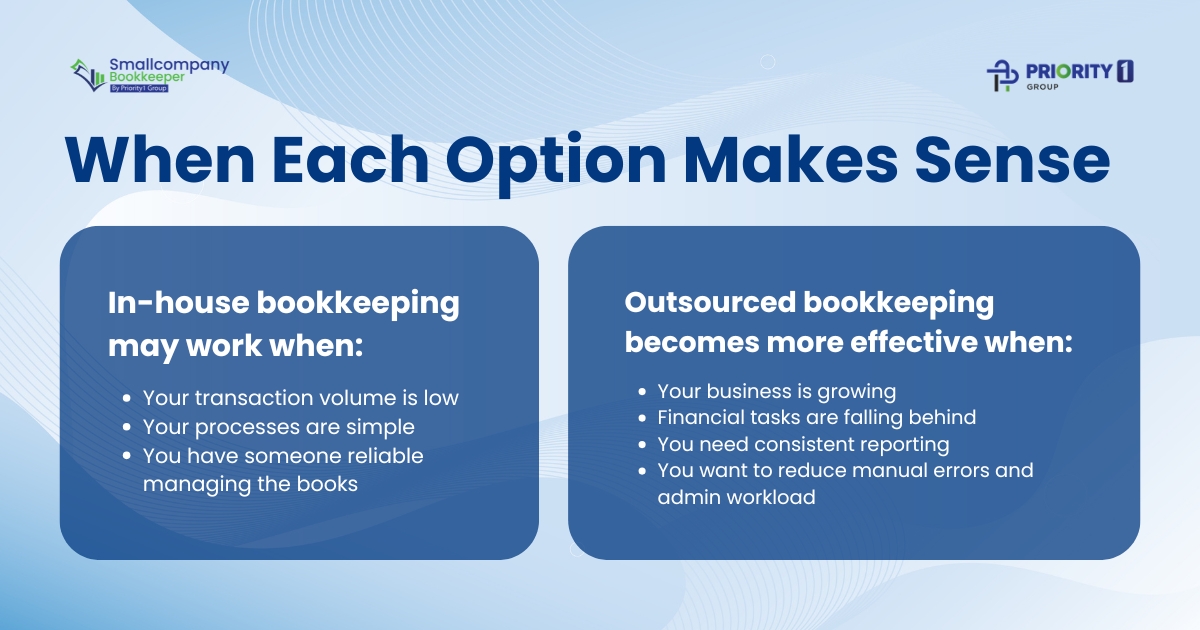
There isn’t a one-size-fits-all answer. The right choice depends on where your business currently stands.
As complexity increases, outsourcing often becomes less of a choice and more of a necessity.
What many businesses overlook is that bookkeeping is not just about recording transactions – it’s about building a system that supports growth.
Without structure, financial data becomes reactive. Using tools like QuickBooks can help automate tracking and reporting, but the real value comes when these tools are supported by consistent processes.
But with the right systems in place, bookkeeping becomes proactive. It gives you insights, clarity, and confidence in your decisions.
This is where the right support can make a real difference.
There is a company called Priority1 Group that helps small businesses across Australia build consistent and reliable bookkeeping systems. By focusing on structured processes, accurate reconciliations, and clear reporting, they help businesses move from scattered records to a more organised and manageable financial setup.
Many business owners hesitate to outsource because they fear losing control. But in reality, control without clarity doesn’t help.
What actually matters is knowing:
Outsourced bookkeeping doesn’t remove control – it improves visibility. It gives you a clearer picture of your business without requiring you to manage every detail.
The decision between outsourced and in-house bookkeeping is not just operational – it’s strategic.
In-house bookkeeping works when things are simple and manageable. But as your business grows, the need for accuracy, consistency, and scalability becomes more important. That’s where outsourcing starts to offer real value.
If your current setup feels inconsistent, time-consuming, or unclear, it may be time to rethink your approach. With the right support from a team like Priority1 Group, you can build a system that doesn’t just keep records – but actively supports your business growth.
Because in the end, bookkeeping isn’t just about tracking numbers. It’s about creating clarity, reducing stress, and giving your business the structure, it needs to grow with confidence.