

Construction businesses in Australia operate in one of the most financially demanding industries. Between managing subcontractors, supplier invoices, payroll, equipment expenses, and compliance obligations, financial systems can quickly become difficult to manage if bookkeeping is not handled properly.
Unlike many other industries, construction businesses must monitor financial performance at both business and project levels. Every project carries different timelines, labour costs, material expenses, and payment schedules. Without accurate bookkeeping, it becomes difficult to understand whether jobs are profitable, whether budgets are being exceeded, or whether cash flow problems are developing behind the scenes.
This is why construction bookkeeping requires a more structured approach. Businesses that maintain organised financial records usually gain stronger visibility into project profitability, operational performance, and long-term business stability.
One of the biggest financial challenges construction businesses faces is tracking project costs accurately. Many businesses know how much revenue is coming in, but they struggle to understand how much profit remains once labour, subcontractors, materials, and overhead expenses are properly allocated.
Without proper job cost tracking, businesses often underestimate future projects or fail to notice when certain jobs are becoming unprofitable. Small cost overruns may not seem serious initially, but over time they can significantly affect margins and cash flow.
For businesses managing small company bookkeeping, accurate project costing becomes essential because every labour expense, supplier invoice, and subcontractor payment affects profitability directly. Businesses that track costs consistently usually make stronger pricing decisions and gain clearer financial visibility across projects.
Cash flow problems are extremely common in the construction industry because projects often involve delayed payments, staged invoicing, supplier deposits, and rising labour costs. A business may appear profitable on paper while still experiencing cash shortages because incoming payments and outgoing expenses rarely align perfectly.
Construction businesses often face situations where materials and wages must be paid before client invoices are settled. This creates pressure on working capital and makes financial forecasting much more important.
Managing supplier payments and incoming invoices consistently is critical for maintaining healthy cash flow. This guide on accounts payable vs accounts receivable for small businesses explains why balancing both properly is essential for financial stability.
Many growing construction businesses also choose to work with an Outsourced Bookkeeper to reduce administrative pressure while maintaining more accurate financial records and reporting consistency. This becomes especially valuable when managing multiple projects, supplier invoices, and payroll obligations at the same time.
When bookkeeping systems are updated consistently, businesses can identify problems earlier and make adjustments before cash flow issues become serious operational risks.
Payroll management in construction is often more complicated than many business owners expect. Workers may move across multiple projects while receiving different pay rates, overtime allowances, and site-based entitlements. Subcontractor arrangements can also add additional reporting complexity.
Without accurate payroll systems, businesses can experience reporting errors, incorrect superannuation payments, and payroll compliance issues. These mistakes not only create financial stress but can also affect employee trust and overall operational stability.
This is one reason why many construction businesses rely on bookkeepers for small business to help maintain organised payroll systems and accurate labour cost reporting. Strong bookkeeping processes help ensure wages, taxes, and contractor payments are recorded correctly and allocated appropriately across projects.
Construction businesses in Australia must manage several ongoing compliance obligations at the same time. GST reporting, BAS lodgement, PAYG withholding, superannuation payments, payroll reporting, and contractor documentation all require accurate financial records and consistent reporting processes.
As businesses grow and take on more projects, these responsibilities become increasingly difficult to manage manually. Small errors in payroll or tax reporting can quickly become expensive if they continue unnoticed over several reporting periods.
Payroll mistakes are especially common in industries with overtime, allowances, and changing work hours. This guide on Single Touch Payroll mistakes explains some of the most common reporting issues businesses should avoid.
Businesses that maintain cleaner financial systems generally find BAS, payroll, and end-of-year reporting far less stressful because compliance becomes part of a structured routine instead of a reactive process.
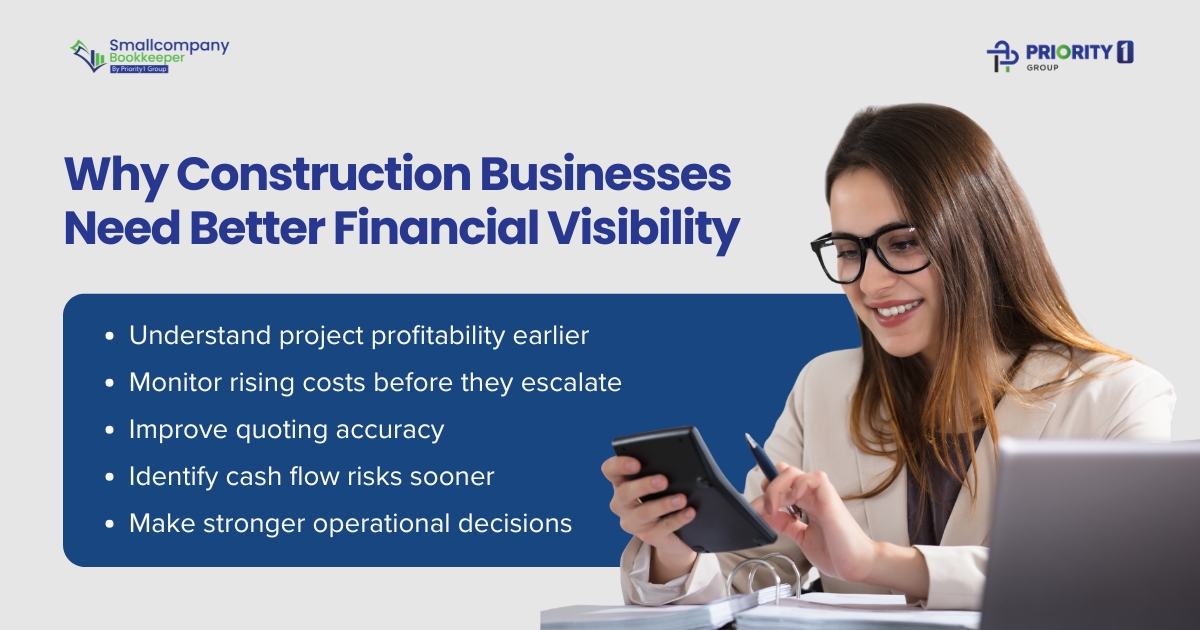
Many construction businesses focus heavily on project delivery while financial reporting becomes something reviewed only occasionally. But businesses that maintain consistent bookkeeping usually gain much stronger control over profitability and operational performance.
Better financial visibility allows businesses to:
The businesses that stay financially stable over time are usually the ones that review financial information regularly rather than waiting until problems appear.
As construction businesses expand, bookkeeping becomes more demanding. More projects, more transactions, and larger payroll obligations increase the risk of financial errors if systems are not maintained properly.
There is a company called Priority1 Group that helps Australian businesses improve bookkeeping structure through reconciliation support, payroll reporting, financial organisation, and compliance-focused processes. By helping businesses maintain clearer financial records and more consistent reporting systems, they support stronger operational visibility and financial control.
Professional bookkeeping support can help construction businesses improve project cost tracking, reduce reporting errors, maintain organised financial records, and create cleaner compliance processes. Most importantly, it allows business owners to focus more on project delivery and business growth instead of constantly reacting to financial issues.
Construction bookkeeping in Australia requires much more than simple transaction recording. Businesses need accurate project cost tracking, structured payroll systems, reliable reporting, and consistent compliance management to maintain financial control and long-term profitability.
Without organised bookkeeping systems, small financial problems can quietly grow into larger operational challenges. But with accurate reporting and consistent financial processes, construction businesses gain stronger visibility into cash flow, project performance, and overall business stability.
If your construction business is struggling with unclear reporting, inconsistent cash flow, or growing financial complexity, working with a team like Priority1 Group can help create more organised bookkeeping systems that support better financial visibility, stronger compliance, and smarter business decisions.