

Hiring employees is a major step forward for any small business. It usually means more customers, more work and a growing need to delegate responsibilities. However, employing staff also brings obligations that must be handled carefully, and superannuation guarantee payments are among the most important.
Superannuation is not an optional benefit that can be delayed until your cash flow improves. It is a legal responsibility. Paying the correct amount on time protects your employees’ retirement savings and helps your business avoid penalties, interest charges and unnecessary administrative work.
The rules are also changing. Employers need to understand the existing quarterly deadlines while preparing for Payday Super, which begins on 1 July 2026. Taking action early can make the transition far easier.
The superannuation guarantee, often shortened to SG, is the minimum amount an employer must contribute to an eligible employee’s super fund. The payment is made in addition to the employee’s wages and generally goes into the employee’s nominated super account or the employer’s default fund.
The SG rate is currently 12%. Under the existing system, this is generally calculated using an employee’s ordinary time earnings. For example, if an eligible employee earns $1,000 in ordinary time earnings during a pay period, the employer generally needs to contribute $120 to the employee’s super fund.
The calculation may look simply, but mistakes can still occur. Problems often arise when businesses use the wrong earnings figure, misunderstand which workers are eligible or wait too long to process the payment. A minor error repeated across several employees can quickly become a larger payroll issue.
Many employees are eligible for superannuation contributions, including full-time, part-time and casual workers. It is important not to assume that casual staff are excluded simply because they work irregular shifts or limited hours.
Some contractors may also be entitled to super when they are engaged mainly for their labour. Having an Australian Business Number does not automatically mean a worker is excluded from super obligations. Employers need to consider the actual working arrangement rather than relying only on the label used in the contract.
Special rules can apply in some situations. For example, employees under 18 generally need to work more than 30 hours in a week before SG applies. Domestic or private workers may also be covered when they work more than 30 hours per week.
If your team includes contractors, casual employees or younger workers, review each arrangement carefully. Correct worker classification can help prevent unexpected liabilities later.
Under the current quarterly system, SG is generally calculated using ordinary time earnings, commonly known as OTE. This usually includes payments for ordinary hours of work, along with certain bonuses, commissions, allowances and paid leave amounts.
Overtime is generally treated differently and may not be included in OTE. However, payroll becomes more complex when staff receive a mixture of ordinary wages, overtime, shift loadings, allowances and commissions.
This is where accurate small company bookkeeping becomes valuable. A consistent payroll and bookkeeping routine help you separate different payment types, review calculations and catch mistakes before they become costly.
Avoid estimating super contributions at the end of the quarter. Your payroll records should be checked during each pay cycle so you always know what your business owes.
For earnings paid up to 30 June 2026, employers generally need to pay SG contributions at least four times a year. The standard deadlines are:
Quarter | Period Covered | Payment Due Date |
Quarter 1 | 1 July to 30 September | 28 October |
Quarter 2 | 1 October to 31 December | 28 January |
Quarter 3 | 1 January to 31 March | 28 April |
Quarter 4 | 1 April to 30 June | 28 July |
The payment needs to reach the employee’s super fund by the deadline. Sending the money on the final day may not be enough if processing takes additional time.
A safer approach is to schedule the payment several business days early. This gives your business time to review the payroll figures, correct any errors, and allow for processing delays.
From 1 July 2026, the timing rules will change significantly. Employers will need to pay superannuation in line with each payday instead of waiting until the end of the quarter. In most cases, the contribution must reach the employee’s super fund within seven business days after the employee is paid.
If your staff are paid weekly, super payments will need to follow that regular payroll rhythm. If employees are paid fortnightly or monthly, your process will need to match those pay cycles.
The new system also introduces qualifying earnings as the basis for calculating SG. This brings ordinary time earnings and certain other payments together under the Payday Super rules.
Payday Super does not mean businesses should panic. It does mean employers need to review their payroll setup, clearinghouse arrangements, and cash flow before the change begins. For a broader preparation guide, read these EOFY 2026 deadlines and tax planning tips.
Payday Super changes the timing of payments rather than the overall SG percentage. Instead of holding contributions until the quarterly deadline, businesses will need to pay smaller amounts more frequently.
For some employers, this may actually make planning easier. Regular payments can prevent a large quarterly super bill from arriving at the same time as BAS obligations, supplier invoices and other operating costs.
However, businesses with tight cash flow should start adjusting early. If you currently rely on the time between payroll and the quarterly deadline, the new system may require a more disciplined approach.
Priority1 Group supports Australian small businesses with structured bookkeeping, payroll assistance and financial administration processes. Creating a reliable routine now can make the Payday Super transition more manageable.
Payroll software can automate calculations and reduce repetitive work, but it is not a substitute for regular review. Incorrect employee details, outdated pay rates or wrongly coded earnings can still create errors.
Your business should maintain accurate records for ordinary hours, overtime, leave, allowances, commissions, bonuses and super contributions. These details make it easier to reconcile payroll reports and investigate differences when something does not look right.
Businesses seeking a clearer understanding of payroll reporting may find this guide to Single Touch Payroll obligations for small businesses useful. STP reporting and superannuation payments are closely connected, so they should be reviewed as part of the same payroll process.
For businesses using QuickBooks or reviewing their software setup, QuickBooks Bookkeeper can help maintain organised financial records and improve day-to-day bookkeeping processes.
Late super payments can result in more than a reminder email. If contributions are not paid in full and on time, an employer may need to lodge a superannuation guarantee charge statement and pay the super guarantee charge.
This can add interest charges and administrative components to the original amount. The process is often more complicated than simply making the missed payment a few days late.
Prevention is the best approach. Bookkeepers for Small Business can help you maintain payroll records, monitor payment schedules and create recurring checks so deadlines are less likely to be missed.
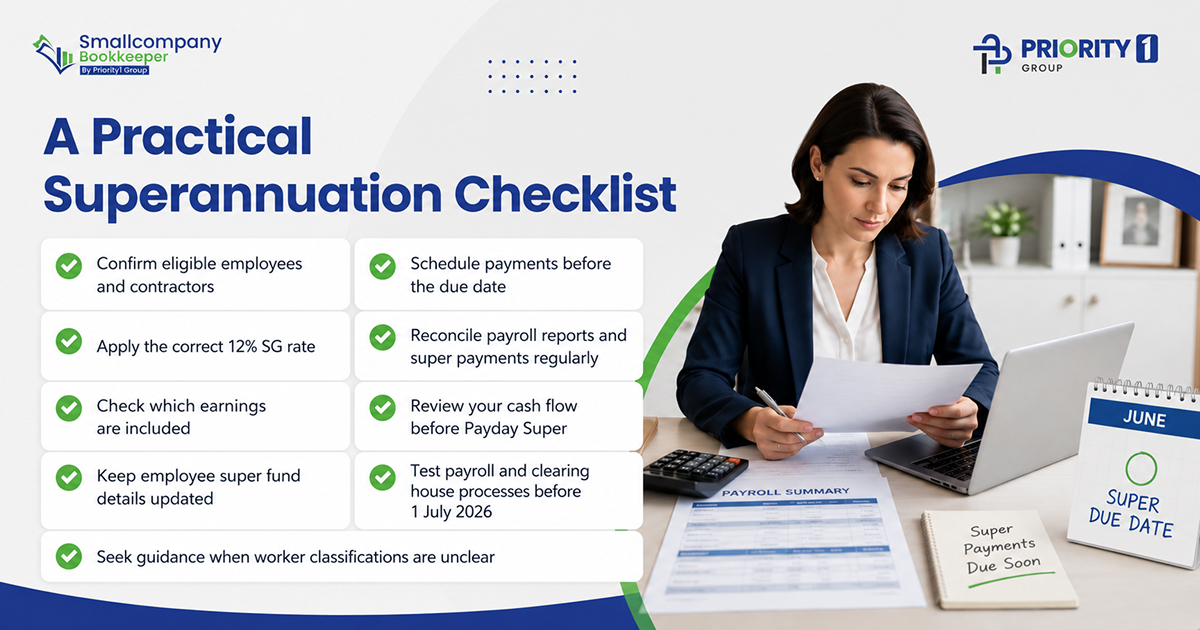
A straightforward routine can reduce the risk of errors. Review these points regularly:
Super should be part of your normal payroll routine rather than a task that only receives attention when a deadline is approaching.
Superannuation guarantee obligations are easier to manage when your payroll records are accurate, your deadlines are visible and your payments are planned in advance. The SG rate is currently 12%, and employers should continue following the quarterly system for earnings paid up to 30 June 2026.
From 1 July 2026, Payday Super will make regular payroll checks even more important. Preparing your systems early can help you manage the change without disrupting your business.
Priority1 Group helps Australian small businesses improve bookkeeping processes, maintain accurate payroll records and reduce the pressure created by recurring financial obligations. With the right routine in place, superannuation payments can become a predictable part of running your business.